On 4 May 2026, the NUS Centre for Trusted Internet and Community (NUS CTIC) hosted the iGYRO Workshop on Trust in AI Chatbots at the Innovation 4.0 Conference Room. The workshop brought together researchers, policymakers, practitioners, and students to examine how trust in AI chatbots is formed, extended, and sometimes misplaced.
As AI chatbots are increasingly used for information, advice, and emotional support, questions of trust have become more urgent. The workshop explored how conversational systems come to appear empathetic, credible, and persuasive, and what it takes for them to be genuinely trustworthy.
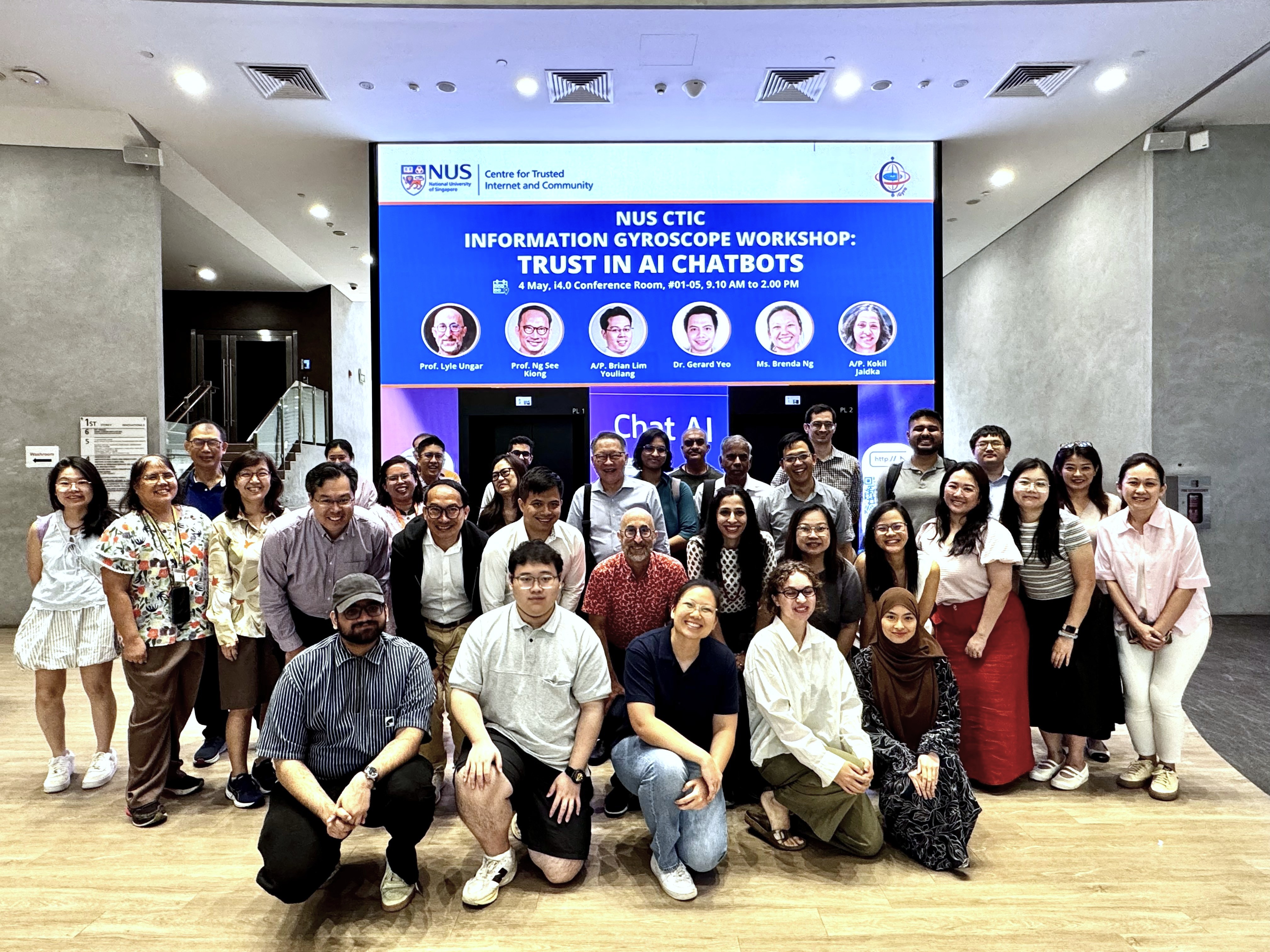
Group photo at innovation 4.0
Recordings of the event are available here:
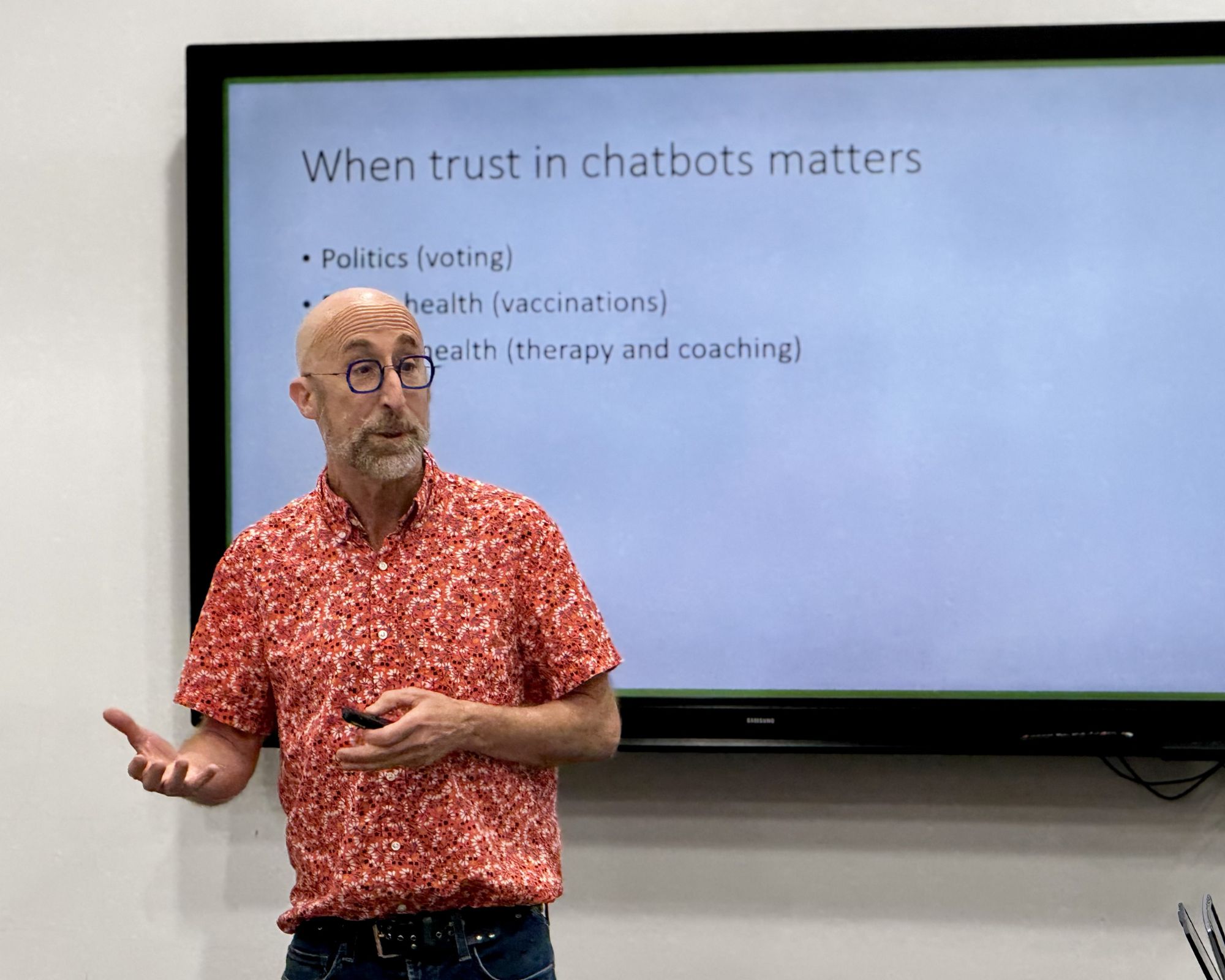
Prof. Ungar delivering his keynote presentation
Keynote: The Illusion of Empathy and the Reality of Persuasion
Prof. Lyle Ungar, Professor of Computer and Information Science at the University of Pennsylvania, delivered the keynote presentation on Trust in Chatbots: The Illusion of Empathy and the Reality of Persuasion. His talk examined what trust is, what drives it, and how it relates to persuasion.
Prof. Ungar discussed how trust in chatbots is shaped by perceived warmth, competence, and beneficence. He shared findings showing that empathy is a key driver of trust, but that empathetic language is not the same as an empathetic conversation. While humans are often perceived as more empathetic than chatbots, how human-like an agent appears can matter more than whether it is actually human.
The talk also examined persuasion in conversational AI, including when a chatbot conversation may or may not be more persuasive than a single tailored message. Prof. Ungar closed by highlighting the importance of building chatbots that are not only trusted, but genuinely trustworthy.
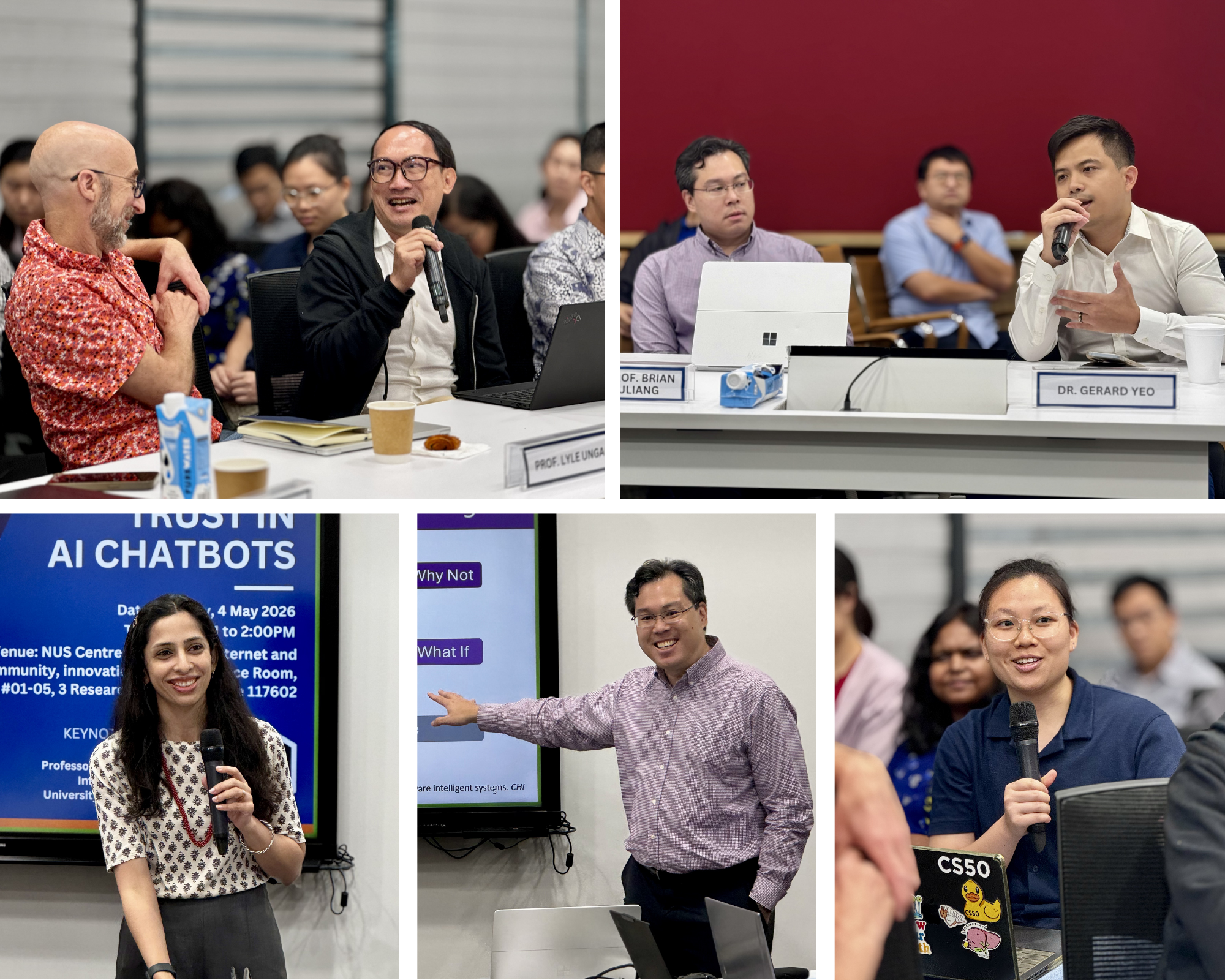
Thought-provoking discussion from the panellists (top from left to right: Prof. Ungar, Prof. Ng, A/P Lim and Dr. Yeo; bottom from left to right: A/P: Jaidka, A/P Lim and Ms. Brenda)
Panel Discussion: Building Trustworthy Chatbots — Care, Credibility, and Design
The workshop continued with a panel discussion on Building Trustworthy Chatbots: Care, Credibility, and Design. The panel was hosted by A/P Kokil Jaidka and brought together Prof. Lyle Ungar, Prof. Ng See Kiong, A/P Brian Lim Youliang, and Dr. Gerard Yeo, with facilitation by Ms. Brenda Ng.
The discussion moved beyond “trustworthy AI” as a technical property alone, considering how trust is shaped by systems, users, institutions, and contexts. Panellists discussed the importance of explainability, credibility, human-AI interaction, accountability, controllability, and user agency.
A key theme that emerged was that trust in AI should not be treated as a goal in itself. Instead, trust should be calibrated. As AI systems become part of everyday decision-making, learning, care, and social connection, it becomes increasingly important to design systems that can explain themselves without misleading users, recognise uncertainty, and refuse tasks where trust would be misplaced.
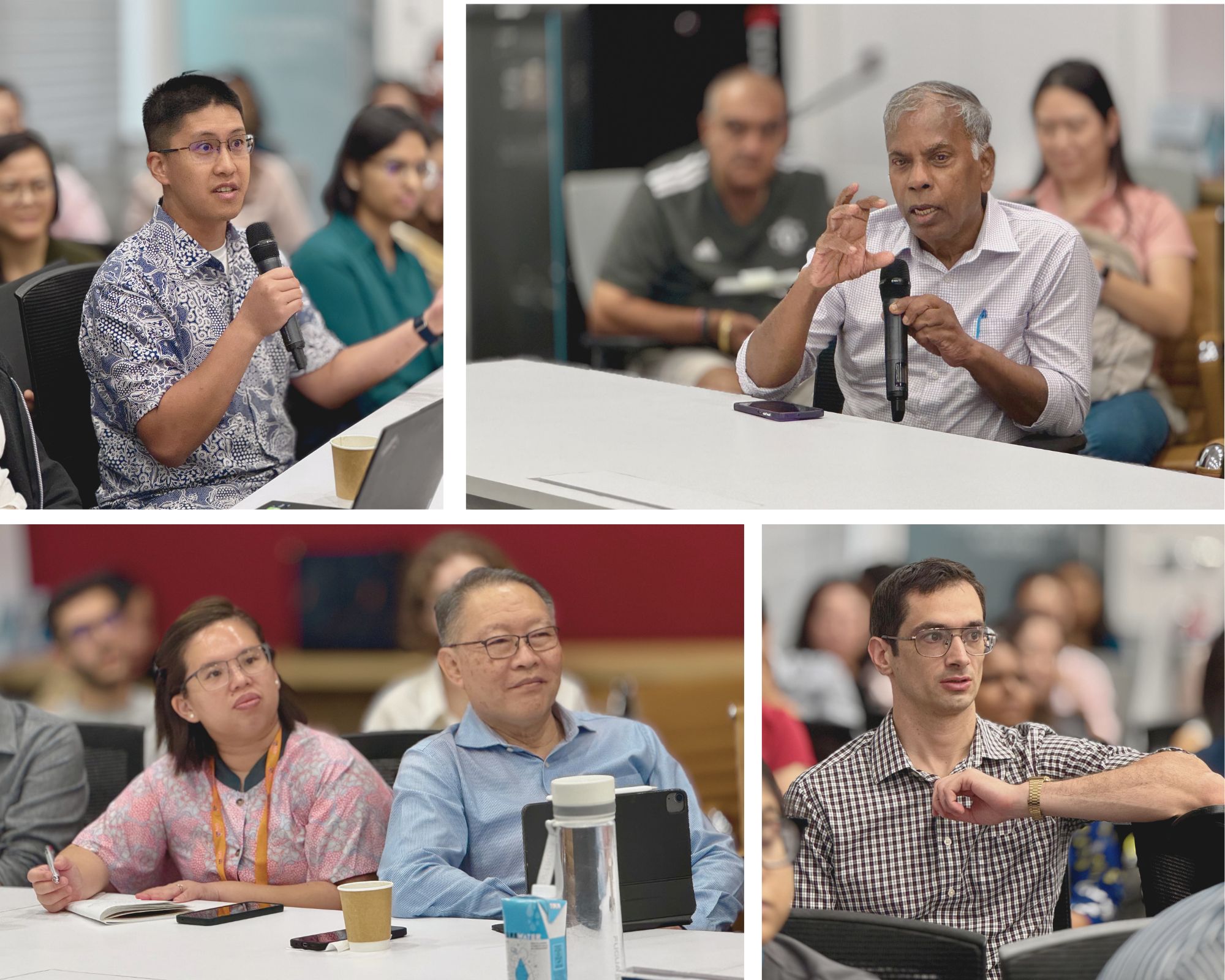
Strong interest and engagement from participants
Key Takeaways
Acknowledgement
The workshop forms part of CTIC’s ongoing iGYRO initiative, which examines trust, misinformation, digital resilience, and the evolving relationship between technology and society, and is supported by the Ministry of Education, Singapore, under its MOE AcRF Tier 3 Grant.